Bureau de l’OMPI en Chine : Soutenir la transformation du système de la propriété intellectuelle face aux défis de l’innovation
The 2025 IPR Nanhu Forum, hosted by Zhongnan University of Economics and Law (ZUEL), grandly opened in Wuhan under the theme “Chinese Modernization and IP System Innovation”. Ms. Liu Hua, Director of the WIPO Office in China attended and addressed the Opening Ceremony.
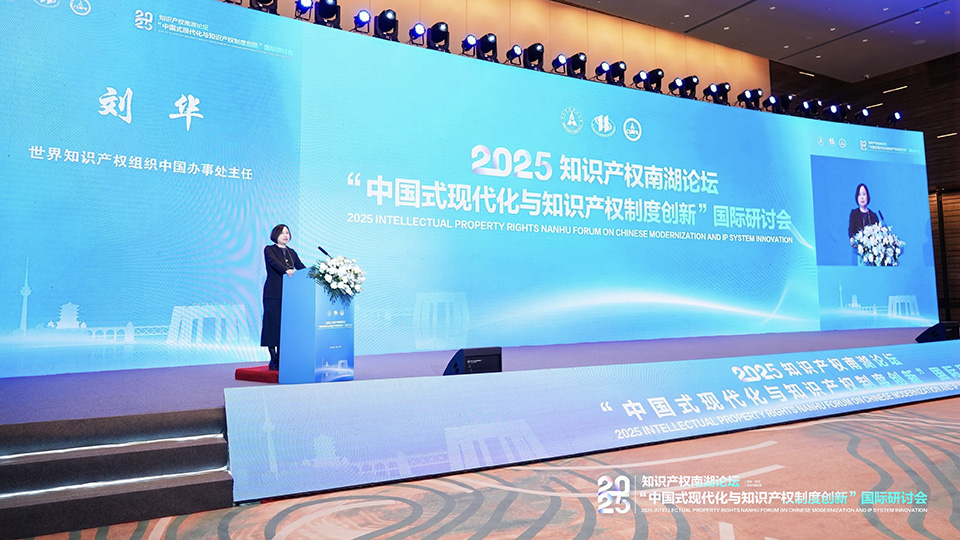
In her remarks, Ms. Liu Hua highlighted that the world is undergoing profound changes driven by two major waves of innovation: the “Digital Era”, characterized by developments in AI and the metaverse among others, and “Deep Science”, involving breakthroughs in biotechnology and nanotechnology, etc. In response to these challenges, WIPO Conversation on IP and Frontier Technologies focuses on key issues such as copyrightability and patentability in AI era, digital security, and the use of digital information, as well as gaps and coordination in related regulatory frameworks. The initiative aims to foster international cooperation and exchange, jointly exploring and formulating IP rules suited for the new era.
Ms. Liu stated that that China is a significant hub for intellectual property innovation and creation, having established its position as a global innovator. WIPO will further strengthen its connections and cooperation with all stakeholders in China, providing closer, timely, and higher-quality services to support the country's efforts in building an innovation-driven nation.
In his written address, Mr. Shen Changyu, Commissioner of China National Intellectual Property Administration (CNIPA) noted that amid accelerating global transformations, there is a growing need to build an IP system aligned with Chinese modernization and the frontiers of scientific and technological development. He called for deepening reform of the IP sector, innovating institutional design, and building an efficient comprehensive management system for IP. These efforts, he noted, should focus on better incentivizing high-level scientific and technological innovation, supporting high-standard opening-up, and serving the development of a modern market system.
President Mr. You of Hubei High People's Court stated that societal progress and technological development have brought new challenges to IP protection and adjudication. He called for continued expert guidance and oversight to strengthen judicial work in intellectual property.
The event also featured opening remarks from Mr. Hou Zhenfa, Secretary of the Party Committee of ZUEL and Vice President of the China Law Society; Mr. Wu Jun, Director General of the Hubei Provincial Intellectual Property Bureau; Mr. Guo He, Executive Vice President of the Intellectual Property Law Association of the China Law Society; Mr. Tang Zhaozhi, Deputy Director General of the Copyright Department of the National Copyright Administration of China and Mr. Li Jian, Chief Judge of the Third Civil Division of the Supreme People’s Court.
Keynote speeches were delivered by Professor Wu Handong, Senior Professor of Wenlan School and Honorary Director of the Intellectual Property Research Center at ZUEL; Professor Dev Gangjee, Director of the Oxford IP Research Centre; Mr. Yu Cike, Executive Vice President of the Copyright Society of China; Mr. Xie Xiaoyong, Vice President and Secretary-General of the China Intellectual Property Society; Professor Graham Dutfield from the University of Leeds; Ms. Diao Yunyun, Vice President of Tencent Legal Department; and Mr. Wang Xiaoqiang, Senior Vice President of CALB Group Co., Ltd.

The two-day forum includes a main conference and eight parallel thematic sessions, covering: modernization of copyright in the new era; patent protection and building China into an IP powerhouse; judicial services and the development of new quality productive forces; trademark law reform and Chinese modernization; IP system innovation in the age of AI; copyright and the content industry; IP governance amid industrial transformation; and a Youth Forum on Intellectual Property.
The IPR Nanhu Forum, since its establishment in 2004, has successfully convened twenty annual sessions across China's major cities including Wuhan, Guangzhou, Shenzhen, Beijing, Nanjing, Shanghai, Chongqing, Zhengzhou, Qingdao, and Changsha. This year's forum returned to its birthplace in Wuhan, convening over 700 distinguished participants from WIPO and other international organizations, alongside preeminent scholars, industry leaders, and legal experts from China, the UK, United States, Germany, Japan, South Korea, and Portugal for substantive deliberations on cutting-edge intellectual property issues.
12 avril 2025