What do women designers in the Central European and Baltic States create the most?
7 mars 2025
7 mars 2025 ・ 2 minutes reading time

Over the past three decades, the industrial design sector in Central European and Baltic States (CEBS) has experienced remarkable growth, with design filings increasing significantly. This expansion reflects broader economic and technological advancements, underscoring the key role of industrial design in shaping the region’s manufacturing and consumer industries.
A newly published report by WIPO shows that a crucial aspect of this evolution is the growing participation of women in industrial design. Historically, women have made significant contributions to the field, yet their participation rate in the region remains below 20% with notable disparities across industries.
The CEBS region is particularly active in design fields related to stationery and office equipment, packaging and containers, and building and construction. However, women’s representation in these industries varies widely, ranging from just 7.8% in building units to 21% in stationery.

Women designers are predominantly involved in fields traditionally associated with feminine products, such as clothing and adornments, personal care and pharmaceutical products, and art materials. The highest participation rates are found in clothing (49%), followed by travel goods (26.3%), foodstuffs (24.4%), and articles of adornment (22.6%). In contrast, women are least represented in industries requiring manufacturing, such as printing and office machinery (3.7%), arms (3.9%), musical instruments (5.6%), and machines (6.2%).
Women’s participation does not depend only on the industry, but on the type of applicant as well.
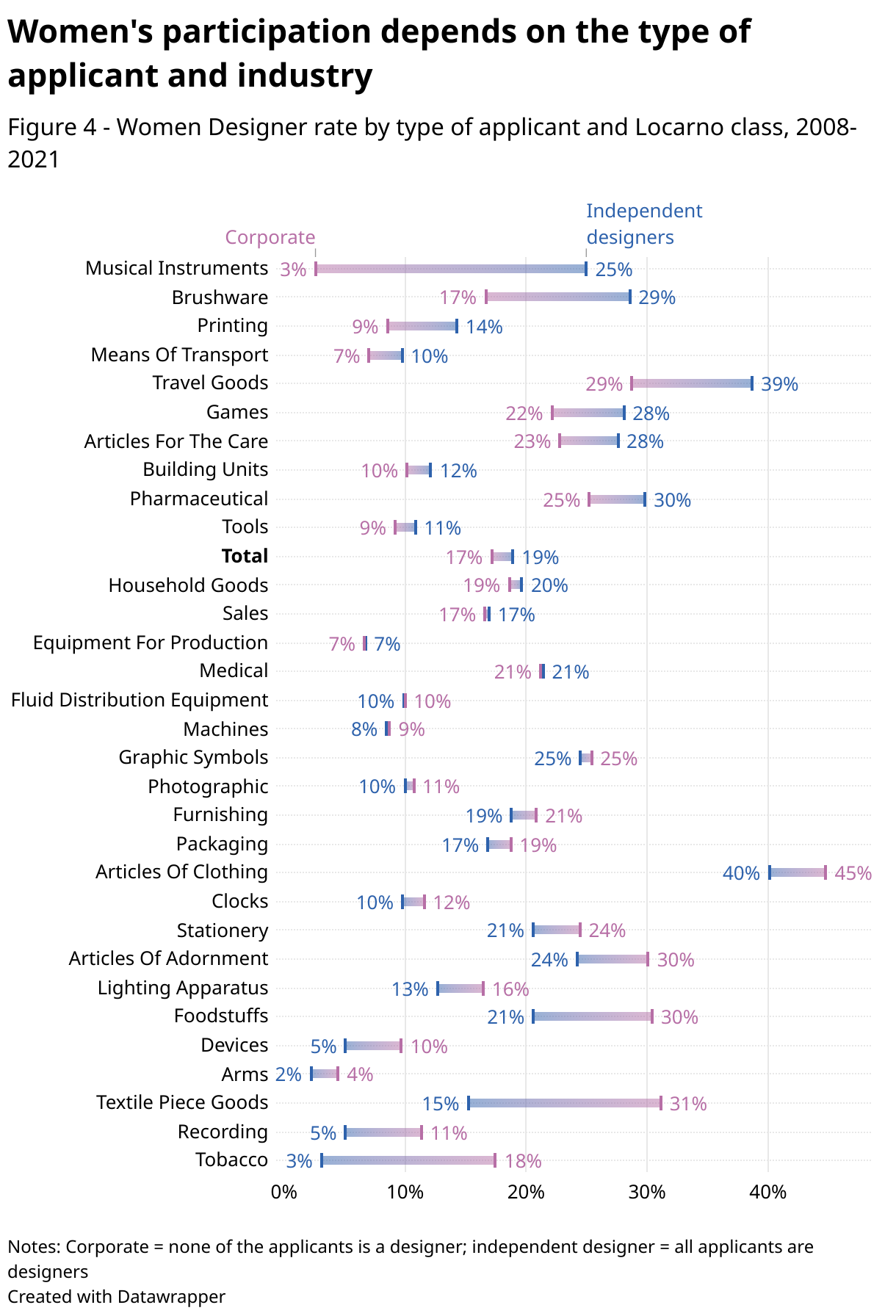
In sectors where women are more active, a greater proportion of them register designs as corporate applicants rather than independent designers. Conversely, in industries where their presence is minimal, such as printing or musical instruments, women are more likely to file as independent designers than as part of corporate entities.
These findings suggest that the underrepresentation of women in certain design fields may not be solely attributed to barriers specific to the innovation ecosystem, but also to broader labor market dynamics.
The report further explores the evolution of women’s participation in industrial design in the CEBS region over time and presents projections for achieving gender parity.