
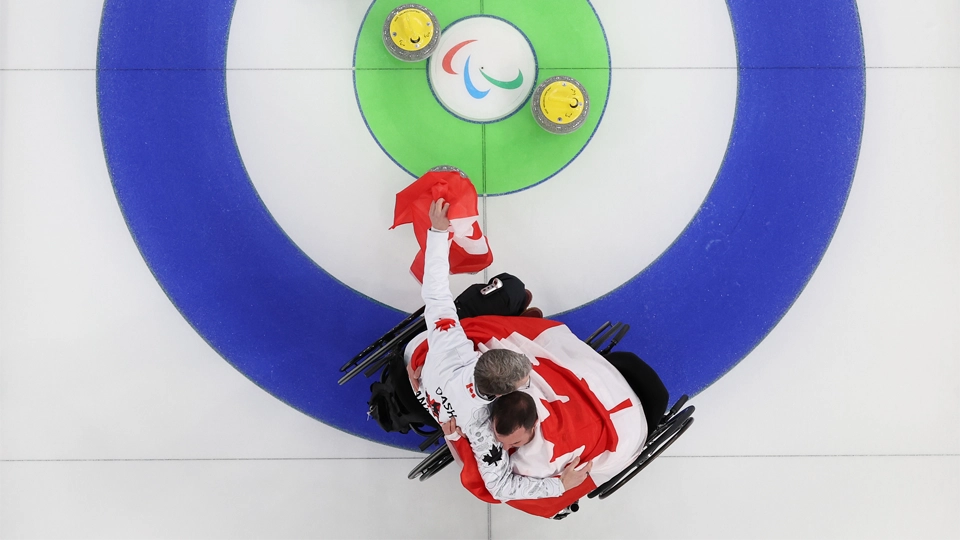
The 14th Paralympic Winter Games, held in Milano and Cortina in Italy from March 6 to 15, were the biggest ever, with more than 600 athletes representing 55 National Paralympic Committees. Organizers reported record crowds for the para ice hockey tournament and more than 400 million views of video content on the Paralympics YouTube channel.
This success demonstrates the enormous growth of the Paralympic Winter Games since they were first held in Örnsköldvik, Sweden, in 1976. The number of participating athletes has more than trebled, and this year there were 160 female competitors, an increase of 18 per cent since 2022.
At Milano Cortina, there were 79 medal events in six parasports: alpine skiing, biathlon, cross-country skiing, ice hockey, snowboarding and wheelchair curling.
The expansion of the Games reflects greater interest in paralympic sports, more opportunities for participation and changing social attitudes. But it is also partly thanks to technological improvements that facilitate participation in paralympic sports generally.
As a January 2026 post by Paralympics New Zealand put it: “innovation on ice and snow sits at the heart of the growth of the Paralympic Movement.”
Impact beyond the Games
While innovation in parasports can help deliver exciting competition and record-breaking achievements, it can also have a positive impact beyond the Games and participating athletes.
For example, Adaptive Winter Sport is a project supported by Milano Cortina 2026’s Education Gen26 program. It aims to help Italian sports federations develop winter Paralympic sports, including through a donation of para ice hockey equipment by Olympic and Paralympic partner P&G.
The visibility of major parasports events can also raise awareness about assistive technology worldwide.
At the Paris 2024 Paralympics, the World Health Organization and the International Paralympic Committee launched the “Equipped for equity” campaign, highlighting “the crucial role of assistive technology for Paralympic athletes to advocate for concerted global action to improve access to these essential health products”.
The campaign found that more than 2.5 billion people worldwide need assistive technology such as wheelchairs and hearing aids. It called on countries to integrate assistive technology into primary healthcare and universal health coverage, stating: “Measures to make assistive technology more accessible and affordable are essential not only for empowering individuals to participate fully in life but also for driving broader societal and economic development. Expanding access to quality-assured, safe and affordable assistive technology reduces health and welfare costs such as recurrent hospital admissions, and promotes a more productive labor force, indirectly stimulating economic growth.”
Constant innovation
Each Paralympic Winter Games brings innovations that push what is possible for athletes to achieve. As the Paralympics New Zealand blog post points out, during the 1980s and 1990s these included early sit-skis and improved prosthetic limbs.
The early 21st century saw lightweight carbon fiber mono-skis, advanced shock absorbers and high-performance prosthetics, while the past decade brought real-time tracking and more advanced communication systems for visually impaired skiers.

The Summer Paralympics have also seen much innovation. The Tokyo 2020 Paralympic Games, for example, saw the introduction of specially designed badminton chairs, modified track racing bikes and 3D-printed customized gloves for wheelchair athletes.
Patents play a crucial role in the development, improvement and dissemination of such assistive technologies. They enable inventors to commercialize their innovations, which, in turn, facilitates further research and development.
The Patent Cooperation Treaty (PCT), administered by WIPO, provides a means to seek patent protection for inventions in more than 150 countries and has been widely used in the parasports field.
Academic researchers to the fore
According to the latest WIPO Technology SPARK Report on sports technology, between 2016 and 2025 sports-related patent filings grew at a compound annual growth rate of 7.6 per cent, compared with 4.4 per cent across all patents.
The report also noted that there was a “distinct pathway” for innovation in parasports: “With 26 per cent of parasport patents originating from academic institutions, compared with 17 per cent across sports technologies overall, the data point to a more research-intensive and collaborative innovation model. This reflects both the technical complexity of assistive technologies and more limited commercialization opportunities, underscoring the critical role of public research and inclusive innovation systems in expanding participation in sport.”
One interesting example is a PCT application for a modulable sports wheelchair, which was published in 2017 naming inventors at the University of Bergamo in Italy. The chair comprises a supporting frame, a front wheel, a pair of rear wheels and a sitting cage.
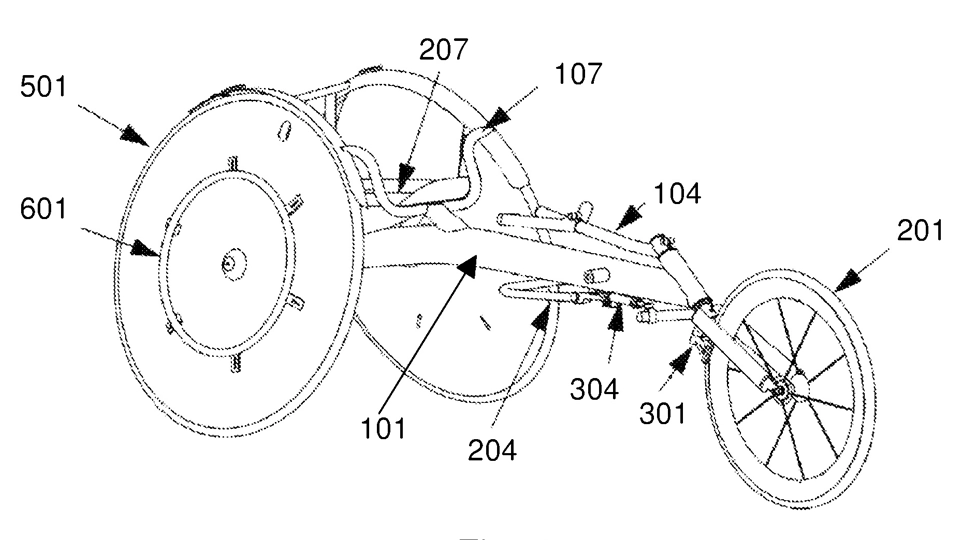
The published application states: “The frame structure has at least two longitudinal sides oriented in the movement direction of the wheelchair and two transverse sides spaced and oriented in the other direction such to form the cage, that therefore takes the shape of a compartment free from internal structural elements intended to receive an athlete with an optimal position for propelling the wheelchair depending on the level and type of disability of the athlete.”
Another example of university-led innovation is a published PCT application for an asymmetrical wheel kit for manual wheelchair and wheelchair fitted with said wheel kit to facilitate the practice of a throwing sport: this patent application, originating from the University of Toulon in France, was published in 2014.
Patents also reveal some surprising uses of technology. For instance, a team of researchers in Canada filed a patent application for an audible hockey puck for the visually impaired, published in 2023.
The puck gives players with visual disabilities information regarding its position and trajectory based on configurable alarms. It can generate one, two or multiple alarms associated with the orientation and/or speed of the puck.
Commercializing innovation
Although universities lead the way, there are a growing number of businesses that focus on research in assistive technology, including prosthetics. For example, WIPO Magazine has featured the Berlin-based company Ottobock (see here and here), which specializes in orthopedic technology.
Meanwhile, a BBC Sounds short published in March 2026 featured an interview with Mike Schultz, a US Paralympic snowboarder who founded BioDapt Inc, which designs, manufactures and distributes high-performance lower-limb prosthetic components for action sports and similar activities.
Also in this field, Japanese company Bridgestone Corporation was named as the applicant on a PCT application for a sole for sports prosthetics, published in 2021. The invention comprises a sole for mounting on a ground-contacting section of a sports prosthetic with a number of grooves.
AI and the future of innovation
The next Paralympic Games will take place in Los Angeles in 2028, with the next Paralympic Winter Games in the French Alps in 2030. The pace of innovation means we will likely see new technologies that further enhance performance at both events.
While it is too early to predict what these technologies will be, it is likely that artificial intelligence (AI) will play a key role. In Milano Cortina, one medalist in the biathlon, Maksym Murashkovskyi of Ukraine, already attributed his success to ChatGPT, saying he used the generative AI tool “as a psychologist, coach and, sometimes, as a doctor”.
There are other ways AI could facilitate innovation in parasports. One that is being explored in Australia by three University of Queensland professors concerns how athletes are classified to ensure there is a level playing field and that no one is gaining an unfair advantage.
“We will use computer vision of para athletes performing a wide array of movements over time to train the system and develop an app,” they wrote in a 2024 blog post. “The app will allow athletes anywhere in the world to video themselves performing sports-related tasks, submit the video and receive an accurate, objective sports class. This will make classifications more trustworthy and will improve access for athletes in rural and remote areas or developing countries.”
Current research in fields such as AI, new communications technologies, sensors and materials has the potential to lead to further game-changing innovation for parasports and beyond. It will be exciting to see how this manifests in future parasports events.
