

For decades, athletes such as Kylian Mbappé, Michael Jordan and Usain Bolt have transcended their respective sports to become global icons. Mbappé crossing his arms and tucking his hands beneath his armpits. Bolt striking his “lightning-bolt” celebration pose after yet another world-record win. Jordan soaring through the air for a decisive dunk. Each has created a recognizable signature move that functions as an iconic expression closely associated with their identity.
Athletes, often positioned as cultural brands unto themselves, are quick to capture these moments and capitalize on their commercial value. Here, trademark law has assumed an increasingly prominent role. Applicants are now proactively seeking protection not just for their names and logos, but for signature movements and sequences of motion too. But in an era when artificial intelligence (AI) is being used to replicate, manipulate and commercialize individuals’ movements, and possibly likenesses, is trademark law still fit for purpose?
Turning signature movements into trademark signs
When examining “motion marks” within trademark law, it is useful to distinguish them from figurative marks, since each protects movement in a fundamentally different way.
Motion marks preserve a defined sequence of frames that depict movement over time. This approach is reflected in the practice of the European Union Intellectual Property Office (EUIPO), which recognizes marks such as “Super Simon”, a short, animated video that combines image and sound, as well as other multimedia and motion marks represented through audiovisual files that depict moving elements or changing positions.
In such cases, protection does not extend to a single image but to the sequence of movement itself – the choreography of motion as it unfolds over time – provided that the sign is capable of indicating commercial origin.
Figurative marks, however, abstract movement into a single, fixed representation. Rather than protecting the movement itself, they secure a stylized, visual expression derived from it – an expression that can embody an athlete’s persona.
Consider the silhouettes associated with Jordan’s “Jumpman” trademark, Bolt’s “lightning bolt” celebration move and Mbappé’s cross-armed pose. In each case, what is protected is not the movement as a sequence, but a single, stylized moment extracted from it.
Despite their differences, both types of mark share the same essential function: to indicate origin. In doing so, they reflect the recognition that movement in sport can operate as a commercial identifier.
This development is a natural response to the evolution of sports branding, as trademark protection has expanded beyond traditional logos to include embodied movement and identity, alongside other non-traditional marks.
Its significance is particularly evident in a digital landscape in which an athlete’s image constitutes a key commercial asset.
Embodying athletics
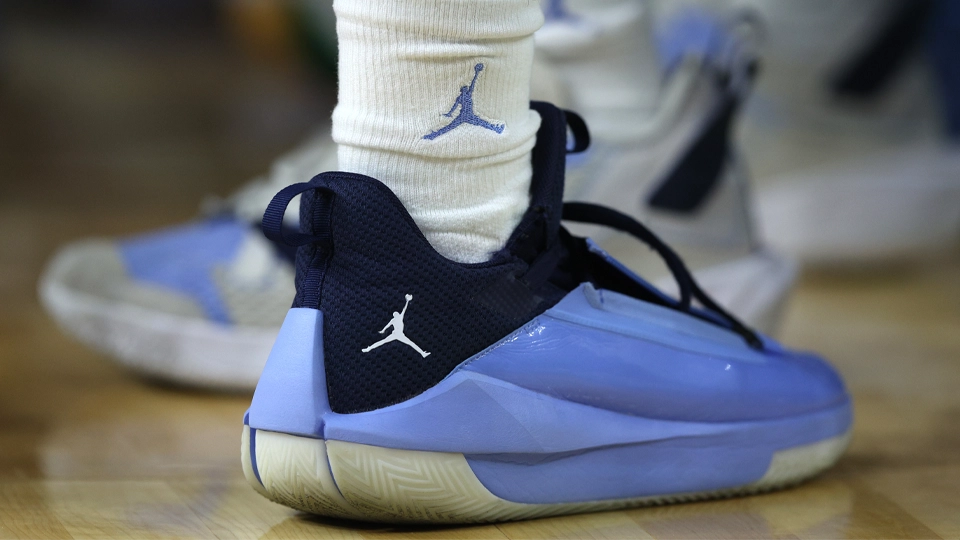
Jordan was one of the first to transform athletic movement into a commercial sign. The “Jumpman” trademark, owned by Nike, Inc., was registered in the United States in 1989 for footwear and apparel. The mark represents not only the basketball legend’s legacy but also a broader association with excellence in sport. Here, the sporting act – a mid-air dunk – was abstracted into a minimalist silhouette.
What started as an athlete’s move became a reproducible commercial signifier associated with Jordan’s sporting persona. It continues to underpin his commercial legacy today, most notably through its use in Nike’s Air Jordan product line.
Usain Bolt’s “lightning bolt” victory celebration, with his hands angled diagonally towards the sky, quickly became widely recognized as the Jamaican athlete hit his stride in the late 2000s – and he sought protection for his signature move early.
Bolt first registered his stylized pose as a trademark in 2009. After the registration expired due to non-use in 2017, he filed a new application in 2022 for its use in a broad range of goods, such as clothing, bags, jewelry and sunglasses. The victory pose, once a gesture for the crowd, is now a licensed commercial identifier.
The same logic underpins Kylian Mbappé’s cross-armed goal celebration, registered as a trademark in the European Union in 2018 and used in a broad range of goods that includes clothing, footwear and textiles.
By registering a stylized version of his pose as a trademark, the French footballer ensured that a gesture born in competitive play can operate as part of his broader commercial portfolio.
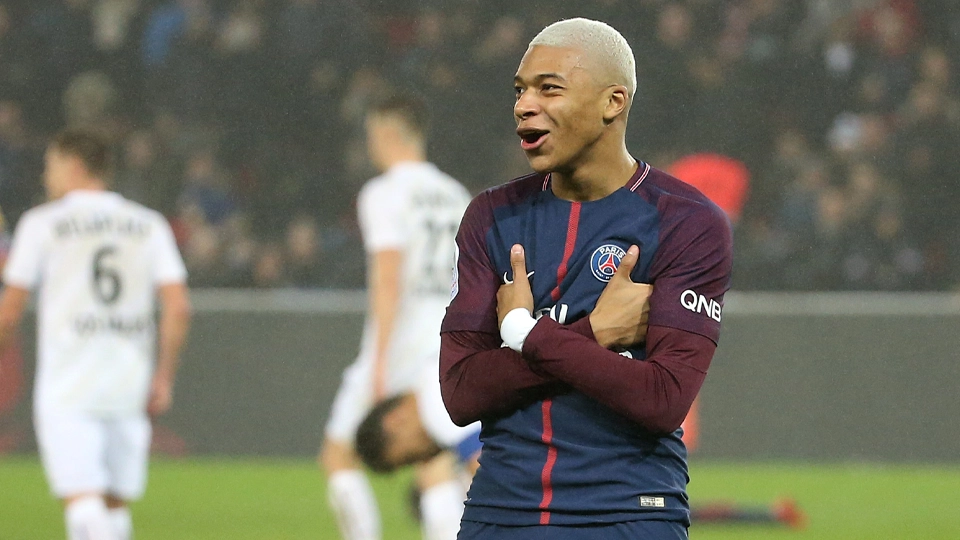
Bolt’s celebration move, Jordan’s airborne silhouette and Mbappé’s folded-arms pose are trademarks that, aside from their primary use as a source identifier for the branding and sale of merchandise – particularly jerseys, shoes and other apparel – now encapsulate iconic moments of embodied expression.
The sportsmen have thus leveraged trademark law not only to license branded merchandise, but also to reinforce personality-based protection by securing control over distinctive signature movements that have become inseparable from personal identity.
Trademarks and synthetic media
In a digital environment shaped by synthetic media, the framework of trademark law has become increasingly unstable. With generative AI systems capable of simulating distinctive human motion, third parties can recreate, or closely approximate, recognizable poses or celebratory moves without permission.
Unlike traditional counterfeiting, AI reproduction does not require the copying of a fixed logo or recording. A generative system trained on audiovisual data can simulate a signature celebration move without duplicating specific footage.
For example, a generative system trained on widely available footage could produce a clip of Bolt striking his signature victory pose in a new context, without reproducing any specific original recording.
The resulting output may be recognizable to viewers as associated with the athlete, although it is synthetically generated and not directly copied from existing footage.
The commercial force of such synthetic media lies in recognizability rather than identity. Yet trademark doctrine remains structured around concepts such as “use in the course of trade” and the “likelihood of confusion”. Those concepts become more difficult to apply when synthetic gestures circulate virally, often in seemingly non-commercial environments, before being indirectly monetized through advertising revenue, brand association or platform visibility.
This diffusion makes it more difficult to identify when and by whom the sign is used “in the course of trade”, even where clear economic value is ultimately derived.
Advent of AI poses fundamental questions
Beyond questions of use in the course of trade, synthetic media also complicate the assessment of similarity between trademarks. The resulting output may reproduce the signature celebration move without replicating it frame by frame.
For example, a third party could use AI technology trained on footage of Jordan’s movements to approximate his split-leg silhouette, producing an output that is functionally the same as the Jumpman trademark but not an exact replica.
This raises the fundamental question: should trademark infringement be assessed through technical comparison, through the overall impression conveyed by the gesture, or both? The line between inspiration and appropriation is increasingly difficult to draw.
The question is not new. Infringement arising from signs that are not identical, but which convey a similar overall impression, was recognized under trademark law before AI. For instance, a hand-drawn silhouette approximating the Jumpman logo associated with Michael Jordan could, depending on the circumstances, give rise to a likelihood of confusion or association.
However, synthetic media intensify the issue by enabling the rapid generation of multiple, slightly varied iterations of a gesture, making it more difficult to define the relevant “sign” and to apply traditional comparison frameworks consistently.
Synthetic media also highlight the limits of trademark law when it is deployed to protect elements of personality. Although the unauthorized digital replication of a signature gesture such as Mbappé’s may inspire claims of trademark infringement, unfair competition and image or publicity rights concurrently, the underlying rationale for those claims would differ. Trademark protection is confined to safeguarding signs that indicate commercial origin; it was not conceived as a general regime for maintaining control over one’s own identity.
The implications extend beyond questions of commercial exclusivity. When AI-generated content places a signature gesture within a fake endorsement, the issue shifts from dilution to one of misrepresentation of the athlete.
For example, a synthetic clip showing Bolt’s victory pose or Jordan’s Jumpman silhouette in an advertisement could suggest a commercial link that does not exist, damaging their existing sponsorship arrangements and exposing them to reputational risk in markets where such associations are sensitive. In a digital environment where such content can be created and shared at scale, motion marks illustrate both the flexibility of trademark law and its limits when used to control how a person’s identity is reproduced.
In such situations, trademark law alone may prove insufficient. Its focus on source identification does not fully capture the harm that can arise from the unauthorized exploitation of persona.
Personality-based rights – where recognized – are better suited to addressing this issue. They protect the commercial value of identity itself, rather than merely its function as a badge of origin.
Used in conjunction with trademark protection, personality-based rights offer a more coherent response to synthetic uses that appropriate not just signs, but the persona of the individuals behind them.
Redefining the boundaries of trademark protection
The evolution of motion marks reflects a broader transformation in sports branding: movement itself has become a commercial asset. As the examples of Bolt, Jordan and Mbappé demonstrate, gestures born in competition can be parlayed into proprietary signs that can then be licensed and enforced across global markets.
Trademark law has accommodated this development, extending protection beyond names and logos to embodied expressions of identity.
Yet the rise of synthetic media is testing the boundaries of that expansion. When recognizable human movement can be generated, manipulated and monetized without the athlete’s participation, the distinction between sign and persona becomes increasingly blurred. Trademark law offers important tools, but it was not conceived as a comprehensive regime for governing digital identity.
The challenge lies in calibration. Protection must remain sufficiently robust to safeguard distinctive signature movements, while avoiding an overextension that converts expressive human conduct into an expansive private monopoly.
In the digital era, the future of motion marks will depend not only on flexibility, but on a clearer articulation of where trademark protection ends and personality-based interests begin.
About the author: Nedim Malovic is Trademark/IP Counsel at ASSA ABLOY and serves on the board of the Swedish Anti-Counterfeiting Group (SACG). He is a skilled IP commentator, having contributed several years to the IPKat blog, where he covered developments in copyright and trademark law. He has also published academically, including in the Journal of Intellectual Property Law and Practice (Oxford University Press) and is active as a speaker, for example during the 2024 EUIPO Case Law Conference and WIPO AI Conversation on synthetic media.


