Scam Warning - Spoofed Calls, Phishing Emails, Fraudulent Payment Requests
- This email address has no connection to WIPO or any official IP Office
- WIPO's official email addresses exclusively use the "wipo.int" domain
- You should not respond to any communication coming from this address
- You should not make any payment requested through this or any similar fraudulent email address
If you think you’ve been scammed contact us.
If you think you’ve been scammed contact us.
If you think you’ve been scammed contact us.
Help us protect the IP community
IP scams target businesses and innovators worldwide. Our free, adaptable communications materials can help you raise awareness across your network.
Access Free Assets

-
How can I spot a fraudulent email?
-
How can I spot a spoofed call?
-
What should I do if I think I’m being scammed?
-
Learn more about spotting scams through examples
-
Latest scams
How can I spot a fraudulent email?
1. Check the sender
Verify that the sender's email address contains the "wipo.int" domain. Be aware, however, that email addresses can be spoofed or impersonated.
2. Analyze the content
Our language excludes urgencies and threats. We will only request personal information through our official platforms (for the creation of a WIPO Account). Be cautious of any email creating pressure to act immediately. And remember that we will never ask you to make an unsolicited payment, with instructions on how to do so, in our written communications.
3. Verify the links
Before clicking any link, hover over it to preview the URL and check whether it contains the "wipo.int" (or "upov.int") extension.
4. Check for attachments
Be cautious of unexpected attachments. We will never ask you to download unsolicited files or software.
5. Look at the overall quality
Watch for poor grammar, spelling mistakes, or unusual formatting, as these are common indicators of fraudulent emails.
6. When in doubt, verify
If you are unsure about the legitimacy of an email claiming to be from WIPO, do not respond or click any links. Contact us directly to confirm its authenticity.
How can I spot a spoofed call?
1. Pay attention to the questions asked
Our employees will never ask you for personal or payment information over the phone. If a caller claims to be from WIPO and requests such information, this is a strong indicator of a fraudulent call. Do not provide this data to anyone.
2. Be cautious about payment requests
Fees charged for WIPO services are to be paid directly to the International Bureau or, where applicable, to the national/regional IP Office. Payments should never be made to third-party services or organizations.
3. Do not act under pressure
Scammers often create a sense of urgency or threaten consequences to push you into making quick decisions.
4. Verify the caller's identity
If you receive an unexpected call from someone claiming to be from WIPO, do not hesitate to hang up and contact us.
Latest active scams
Scammers are currently using the fraudulent email address admin@wipo-office.com to impersonate WIPO and other IP Offices, including the EPO and EUIPO. These fraudulent emails falsely demand payments for Trademark or Patent services. See the examples below.

EPO
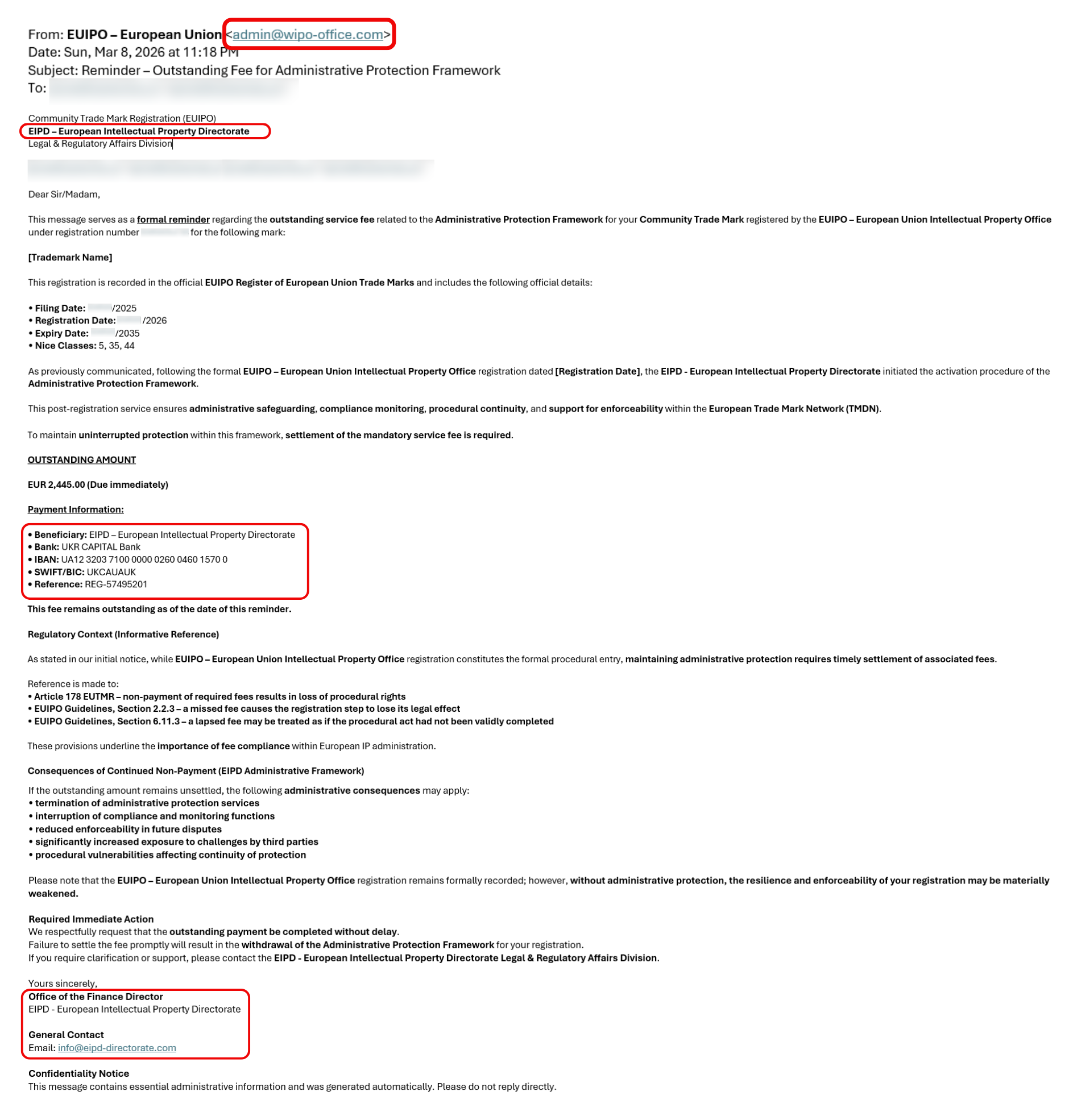
EUIPO - European Union
Please be aware that:
- This email address has no connection to WIPO or any official IP Office
- WIPO's official email addresses exclusively use the "wipo.int" domain
- You should not respond to any communication coming from this address
- You should not make any payment requested through this or any similar fraudulent email address
If you have received an email from this or other suspicious email address, please report it immediately using steps described immediately above.
How can I spot a fraudulent email?
-
Step 1
Check the sender
Verify that the sender's email address contains the "wipo.int" domain. Be aware, however, that email addresses can be:
- Spoofed: the sender's email address is technically forged to display as a legitimate address (e.g., appearing as "noreply@wipo.int") while the actual origin of the email is entirely different. You can detect this by hovering over the sender's email address, which will reveal the real address behind it.
- Impersonated: the email address is designed to closely resemble a legitimate one but contains subtle differences that are easy to miss (e.g., "wlpo.int" instead of "wipo.int").
-
Step 2
Analyze the content
Our language excludes urgencies and threats. We will only request personal information through our official platforms (for the creation of a WIPO Account). Be cautious of any email creating pressure to act immediately. And remember that we will never ask you to make an unsolicited payment, with instructions on how to do so, in our written communications.
-
Step 3
Verify the links
Before clicking any link, hover over it to preview the URL and check whether it contains the "wipo.int" (or "upov.int") extension.
-
Step 4
Check for attachments
Be cautious of unexpected attachments. We will never ask you to download unsolicited files or software.
-
Step 5
Look at the overall quality
Watch for poor grammar, spelling mistakes, or unusual formatting, as these are common indicators of fraudulent emails.
-
Step 6
When in doubt, verify
If you are unsure about the legitimacy of an email claiming to be from WIPO, do not respond or click any links. Contact us directly to confirm its authenticity.
How can I spot a spoofed call?
-
Step 1
Pay attention to the questions asked
Our employees will never ask you for personal or payment information over the phone. If a caller claims to be from WIPO and requests such information, this is a strong indicator of a fraudulent call. Do not provide this data to anyone.
-
Step 2
Be cautious about payment requests
Fees charged for WIPO services are to be paid directly to the International Bureau or, where applicable, to the national/regional IP Office. Payments should never be made to third-party services or organizations.
-
Step 3
Do not act under pressure
Scammers often create a sense of urgency or threaten consequences to push you into making quick decisions.
-
Step 4
Verify the caller's identity
If you receive an unexpected call from someone claiming to be from WIPO, do not hesitate to hang up and contact us.
How can I spot a fraudulent email?
-
Step 1
Check the sender
Verify that the sender's email address contains the "wipo.int" domain. Be aware, however, that email addresses can be:
- Spoofed: the sender's email address is technically forged to display as a legitimate address (e.g., appearing as "noreply@wipo.int") while the actual origin of the email is entirely different. You can detect this by hovering over the sender's email address, which will reveal the real address behind it.
- Impersonated: the email address is designed to closely resemble a legitimate one but contains subtle differences that are easy to miss (e.g., "wlpo.int" instead of "wipo.int").
-
Step 2
Analyze the content
Our language excludes urgencies and threats. We will only request personal information through our official platforms (for the creation of a WIPO Account). Be cautious of any email creating pressure to act immediately. And remember that we will never ask you to make an unsolicited payment, with instructions on how to do so, in our written communications.
-
Step 3
Verify the links
Before clicking any link, hover over it to preview the URL and check whether it contains the "wipo.int" (or "upov.int") extension.
-
Step 4
Check for attachments
Be cautious of unexpected attachments. We will never ask you to download unsolicited files or software.
-
Step 5
Look at the overall quality
Watch for poor grammar, spelling mistakes, or unusual formatting, as these are common indicators of fraudulent emails.
-
Step 6
When in doubt, verify
If you are unsure about the legitimacy of an email claiming to be from WIPO, do not respond or click any links. Contact us directly to confirm its authenticity.
How can I spot a spoofed call?
-
Step 1
Pay attention to the questions asked
Our employees will never ask you for personal or payment information over the phone. If a caller claims to be from WIPO and requests such information, this is a strong indicator of a fraudulent call. Do not provide this data to anyone.
-
Step 2
Be cautious about payment requests
Fees charged for WIPO services are to be paid directly to the International Bureau or, where applicable, to the national/regional IP Office. Payments should never be made to third-party services or organizations.
-
Step 3
Do not act under pressure
Scammers often create a sense of urgency or threaten consequences to push you into making quick decisions.
-
Step 4
Verify the caller's identity
If you receive an unexpected call from someone claiming to be from WIPO, do not hesitate to hang up and contact us.
What should I do if I think I’m being scammed?
If you receive anything that you were not expecting from us and have doubts about its legitimacy, do not provide information, make any payment or click any link. Instead, follow these steps:
-
Step 1
Contact us directly
Reach out to our Contact Center to discuss the matter.
-
Step 2
Seek internal support
Contact your information security team or attorney as appropriate to report the suspicious communication and seek guidance.
-
Step 3
Check our website
See if similar fraudulent notices have been reported. You can do so on this website by going to the next two sections below. You can also check your national or regional patent office’s website, as they normally have a section dedicated to fraudulent notices.
-
Step 4
Alert your colleagues
Inform all colleagues who might receive similar notices so they are aware and can take precautions.
-
Step 5
Report to the authorities
Make a complaint to the competent government authorities and/or consumer protection groups in your country to help take action against scammers.


Learn more about spotting scams through examples
The best way to protect yourself is to know what a phishing email looks like. Take a look at these examples below and familiarize yourself with the key warning signs to help you identify and avoid fraudulent communications.
More examples of fraudulent messages
- Patents (PCT)
- Trademarks (Madrid Registry)

IPC – Intellectual Property Consulting / WIPO Office
Scam keywords: admin@ipc-consultants.com, IPC, Intellectual Property Consulting
It requests a fee of EUR 2,445 payable within 5 days through bank transfer to a Moldovan bank account (Victoriabank, IBAN MD40VI022512 ...), with the beneficiary listed as "IPC – Intellectual Property Consulting". The email uses threatening language such as "final notice," "binding and non-negotiable," and "irreversible enforcement consequences" to pressure recipients into paying.

EIPD – European Intellectual Property Directorate / Fake EUIPO Administrative Protection Fee Demand
This email falsely informs recipients that their Community Trademark registration recorded with the EUIPO (the European Union Intellectual Property Office) requires immediate payment of an "Administrative Protection Framework" fee.

Fake WIPO Trademark Registration Notice Promoting Unnecessary Legal Services
This fraudulent letter falsely informs recipients that their international trademark application "has been accepted by WIPO and is now proceeding under the Madrid Protocol."
Unlike typical fee-demand scams, this letter takes a more subtle approach: rather than directly requesting a payment, it pressures trademark owners into hiring and paying "local representatives" in all designated countries by fabricating an urgent legal requirement to do so. It misrepresents real regulatory references and national trademark laws to create an appearance of legitimacy and reproduces WIPO's actual Geneva address and official branding to appear credible.
WIPO does not send unsolicited trademark registration notices directing applicants to appoint local representatives through third-party contacts.

Fake WIPO Accounts Reconciliation Phishing Email
This email falsely impersonates the WIPO Accounting Department, claiming to conduct an "annual bank reconciliation audit" of outstanding balances.
It attempts a two-pronged attack: first, it requests recipients to share confidential financial information — including a list of open invoices and outstanding payments — by clicking a suspicious link to an "Access Solvay-WIPO Folder Now" shared folder, likely designed to harvest credentials or sensitive financial data. Second, it instructs recipients to "hold any payments until further notice," a classic business email compromise (BEC) tactic used to later redirect payments to fraudulent accounts. The email originates from Accounting.WIPO@encrypt-email.org, an unofficial address entirely unrelated to WIPO, while reproducing WIPO's official logo and Geneva address to appear legitimate.
WIPO never communicates through third-party encrypted email domains and all official correspondence originates exclusively from @wipo.int email addresses.

Fake WIPO International Mark Renewal Fee Demand via Bitcoin
This email falsely informs recipients that their International Mark registration recorded with WIPO requires an immediate renewal fee payment of EUR 1,970.00.
Lorem ipsum dolor sit amet
Latest scams
IPC – Intellectual Property Consulting / WIPO Office
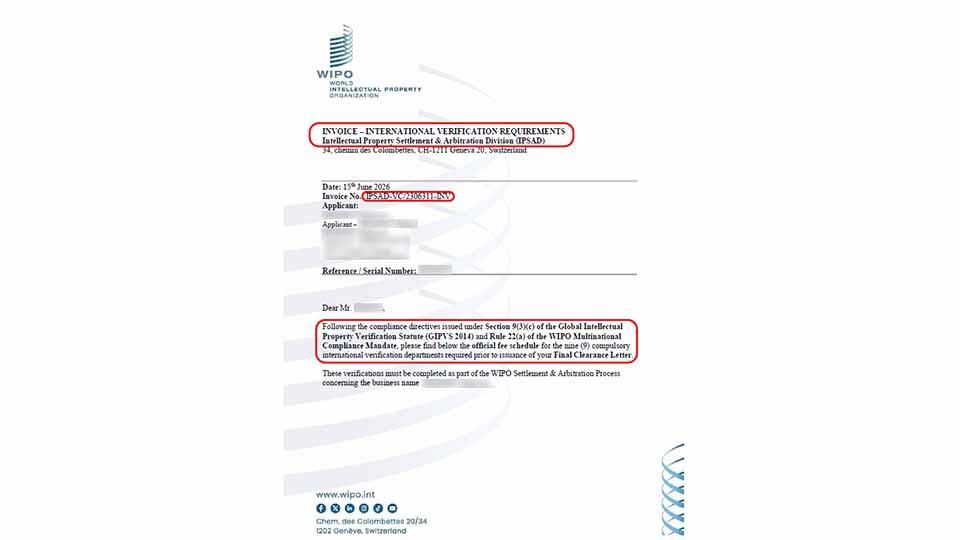
IPSAD – Intellectual Property Settlement & Arbitration Division
This fraudulent invoice, mimicking official WIPO correspondence by misusing WIPO's real Geneva address and logo, falsely claims to originate from a non-existent body called the "Intellectual Property Settlement & Arbitration Division (IPSAD)."
It falsely informs recipients that their intellectual property registration is subject to fees for "nine (9) compulsory international verification departments," required prior to the issuance of a so-called "Final Clearance Letter."
The document invents entirely fictitious legal frameworks, including "Section 9(3)(c) of the Global Intellectual Property Verification Statute (GIPVS 2014)" and "Rule 22(a) of the WIPO Multinational Compliance Mandate" — neither of which exist — to create an appearance of legal legitimacy and urgency.
Learn more about Patent scams (PCT)
Learn more about Trademark scams (Madrid Registry)
Learn more about patent scams (PCT)
Learn more about trademark scams (Madrid System)
Learn more about spotting scams through examples
The best way to protect yourself is to know what a phishing email looks like. Take a look at the two examples below and familiarize yourself with the key warning signs to help you identify and avoid fraudulent communications.
More examples of fraudulent messages
- Patents (PCT)
- Trademarks (Madrid Registry)
- Arbitration and Mediation
Example 1. Fraudulent Trademark Registration Notice impersonating WIPO Madrid

Trademark registration notice
This email fraudulently claims the recipient's trademark faces a competing claim, falsely stating that WIPO handles trademark opposition or infringement disputes. It urgently demands a response to "protect" the trademark and deceptively uses an alleged WIPO colleague's name to lend credibility to this fake legal notice.
Example 2. Fraudulent email impersonating WIPO's Accounting Department coming from Accounting.WIPO@encrypt-email.org

Trademark registration notice
This email fraudulently claims the recipient's trademark faces a competing claim, falsely stating that WIPO handles trademark opposition or infringement disputes. It urgently demands a response to "protect" the trademark and deceptively uses an alleged WIPO colleague's name to lend credibility to this fake legal notice.