Microwave Chemical’s IP Strategy: Using the PCT to Drive Global Partnerships and Innovation
December 16, 2025

Interview with Mr. Yasunori Tsukahara, Representative Director and Chief Strategy Officer (CSO) of Microwave Chemical Co., Ltd., about the company’s use of the PCT System. This interview was conducted in Japanese in February 2025, at the company headquarters in Osaka University Photonics Center, Suita City, Osaka.
Key Points
- The company is a technology provider that conducts research and development of chemical processes using microwave technology and engineering of reactors for chemical plants based on customer orders.
- In joint development with customers, intellectual property (IP) rights for equipment and processes belong to the company, while product IP rights belong to the customer, ensuring the company's business is not hindered while strengthening its technology platform through collaborations.
- With a clear business strategy, the company protects its technology with a limited number of patents.
- The company selects PCT national-phase entry countries based on manufacturer, target market, and competitor locations, obtaining patents in many countries and regions including the US, Europe, and China.
— Please tell us about your business.
Microwave technology is a means of energy transfer, and its greatest feature is the ability to selectively transfer energy to specific substances. It began to be used in microwave ovens in the 1960s and was used on a laboratory scale in the chemical industry in the 1980s with numerous papers published; but scale-up was not successful, and application to chemical plants was not achieved.
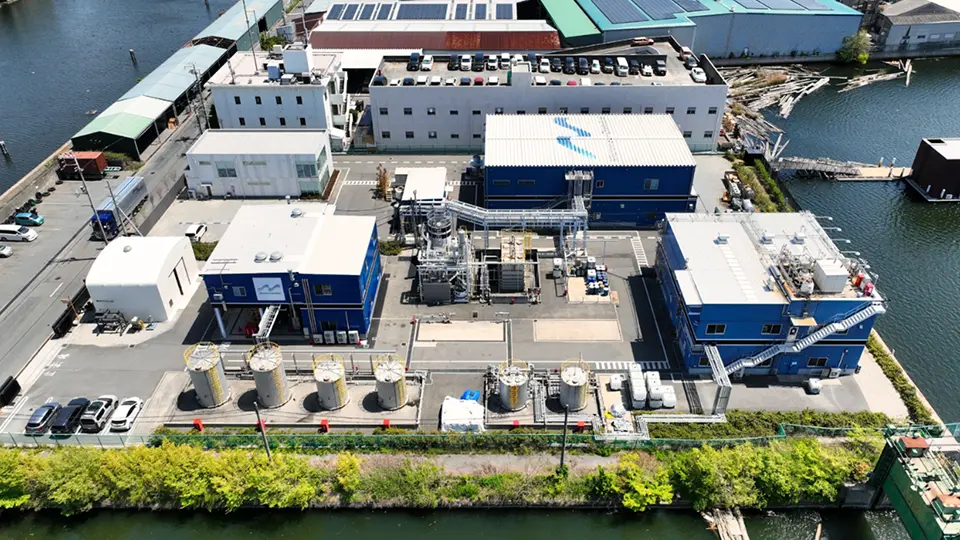
Our company was established in 2007 with the goal of transforming the chemical industry using microwave technology. In 2014, we launched the world's first large-scale microwave chemical plant and manufactured and shipped raw materials for colored newspaper ink for five years, proving that microwave technology could be applied to chemical plants. Currently, we have three demonstration buildings at our Osaka facility with 18 rooms for bench- and pilot-scale demonstration development, and we operate on a business model of providing technology platforms to customers through laboratory to demonstration processes.
— What is your business model?
Our business consists of four major phases:
- research and development (1-2 years);
- demonstration development (1-3 years);
- implementation (full-scale development) (2-3 years); and
- manufacturing support (1+ years).
In total, the process takes at least seven years, and our business model is based on receiving development fees as compensation for our technology platform.
Our customers span a wide range of industries including chemicals, electronic materials, pharmaceuticals, as well as resource development and mining processes. While our customers are primarily major and medium-sized Japanese chemical manufacturers, we also do business with pharmaceutical manufacturing companies and overseas chemical manufacturers.
— What is your intellectual property policy?
For the core technologies supporting our technology platform, which fall into four categories (basic physical property evaluation, control, simulation, and fundamental mechanisms), we keep confidential those technologies that cannot be recognized externally, while patenting or making public those technologies that can be externally recognized. We protect our technology by making the design rationale a black box.
Regarding rights allocation with customers, our basic policy is that firstly, equipment and processes belong solely to our company, and secondly, that products belong solely to the customer.
We implement various projects with different customers, but our primary consideration is to ensure contracts do not prevent our own implementation in the future.
— How do you use the PCT?
For patent applications, we file PCT applications, partly because overseas markets are larger, and we have over 160 applications as of the end of 2024.
For PCT national-phase entry, we consider whether a country is a production country, a consumer country, and how many companies in that country are in the field we're filing in. National-phase entry destinations vary by technology field, but we make sure to enter the US, Europe, and China. Since there are many entry countries, it costs about 10 million yen to obtain a single patent in multiple countries, so we believe it's necessary to be selective in filing.
We file in Japan first, then file PCT applications claiming priority. We request accelerated examination in Japan, and if patentability seems unlikely, we withdraw the application; if patentability seems promising, we proceed with PCT filing.
For technology startups, IP strategy is extremely important, and we believe it's crucial to file applications with a clear business focus."