Japanese company KUCHOFUKU makes cooling clothing to keep people safe in the heat, moving air across the skin to evaporate perspiration.
Japan, summer 2025. Average temperatures soar past historical highs, and humidity hovers uncomfortably around 75%. Still, work must go on. Somehow, construction crews, delivery drivers, and factory workers move with an unexpected lightness. Look closely and you will find a clue: many wear long-sleeved garments that puff slightly. In the lower side back of those garments, small fans direct airflow, whisking away heat and moisture. Only two decades ago few imagined such a sight—except for one inventor, Hiroshi Ichigaya, who believed there was a better way to keep people safe and productive without burdening the planet.

This is the story of KUCHOFUKU Co., Ltd., the company behind a deceptively simple idea: cool the person, not the space—and of its intellectual property strategy that helped turn that idea into a durable advantage.
The Inventor’s Journey: From Sony Engineer to Entrepreneur
Thirty years ago, Ichigaya found himself in Kuala Lumpur, Malaysia. Skyscrapers were rising at a dizzying pace, and with them came a question: What would it cost—in energy and in climate impact—to cool these massive structures? An engineer to his core, Ichigaya had already reshaped his career to stay true to his passion of making things. After more than two decades at Sony, he took early retirement in 1991 to continue life not as a manager but as a hands-on technologist. He founded his own company and built a successful business selling cathode ray tube (CRT) measurement instruments to TV manufacturers in Japan, China, Korea, and Southeast Asia.
But the world was moving on. CRT televisions would eventually vanish. Ichigaya knew he needed a new product. Beyond his specialty, his curiosity kept circling back to cooling and climate: How can we reduce wasteful energy use and still keep people comfortable?
KUCHOFUKU Invents Cooling Clothing
In the early 2000s, trial and error defined Ichigaya’s days. Inspired by the Japanese tradition of sprinkling water to cool streets (uchimizu), he studied evaporative cooling—the way evaporation absorbs heat from the environment—and experimented with water-based cooling. But the breakthrough came from a deceptively modest reframing: build a cooling system for the wearer rather than the room. If the person is comfortable, the room does not need to be.
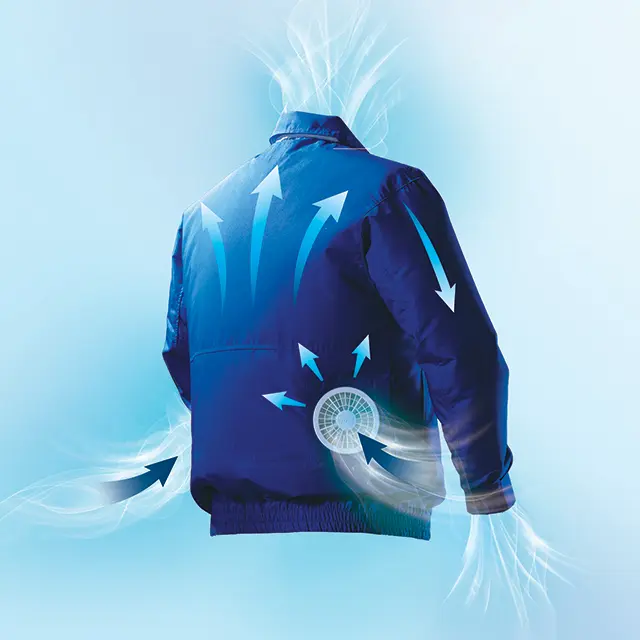
The first prototypes were unconventional: clothing that sprayed water and used fans to drive evaporation. Wearing them in public drew stares. Then came a second insight that made the concept elegantly self-sufficient: humans already produce sweat—nature’s built-in “sprinkling” system. If a garment could simply move air effectively across the skin to evaporate perspiration, the wearer would feel cooler without heavy, power-hungry machinery.
Through successive refinements, “KUCHOFUKU” was born. In 2004, the company began selling early models. Courageous early adopters discovered a new sensation of airflow and steady, safe cooling. For those working in factories and harsh outdoor environments, the product became more than a convenience; it became a lifeline.
At one point, the company had to conduct a recall of 5,000 units. Not one customer requested a refund. The message was clear: “We can’t work without this—please fix it and get it back to us.” That bond with users helped the product cross a critical threshold. As construction workers began wearing the garments on sites across Japan, visibility increased; the media took notice; by around 2010, sales began to increase rapidly.
Top Quality Cooling Clothing with Purposeful Design
As the category matured, other companies began making fan-equipped garments. But the technological edge of “KUCHOFUKU" —rooted in purposeful design and rigorous quality—continued to set it apart. By building and refining key components in-house and focusing on reliability, the company achieved remarkably low defect rates. This commitment to quality not only created trust with users and but also drew major enterprises to pursue joint development partnerships.
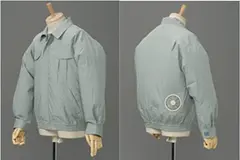
Beyond safety and comfort, the garments proved to be productivity tools—helping reduce heat stress and maintaining focus and output in punishing conditions. And unlike indoor air conditioning, which expends vast energy cooling entire volumes of space (and releasing additional heat outdoors), Ichigaya’s approach uses modest amounts of power to achieve comfort where it matters most: on the person.
KUCHOFUKU’s IP Strategy Behind a Durable Advantage
From the outset, KUCHOFUKU Co., Ltd. pursued a clear intellectual property strategy:
- Protect the core: Secure patents around the fundamental configuration that delivers reliable, efficient, and safe personal cooling—particularly how airflow is generated, directed, and managed within garments to maximize sweat evaporation without discomfort or risk. To date, KUCHOFUKU has filed 85 PCT applications, systematically building international protection across key markets.
- Respect others’ rights: Systematically design around third-party patents to avoid infringement while deepening the company’s own differentiation.
- Keep inventing: Even as competitors entered the category, “KUCHOFUKU” maintained a technology lead through continuous invention, materials optimization, and meticulous quality control, reinforcing brand credibility and user loyalty.
- Integrate IP with operations: Keeping development and manufacturing close to the core team facilitated know-how protection, accelerated iteration, and ensured that quality data fed directly into both engineering and IP decision-making.
This is a textbook example of IP as a strategic asset: patents to protect unique value, trade secrets and process expertise to enhance defensibility, and brand trust as the compounding effect of quality. The result is not just a successful product but a defensible category position.
Beyond Cooling Workwear
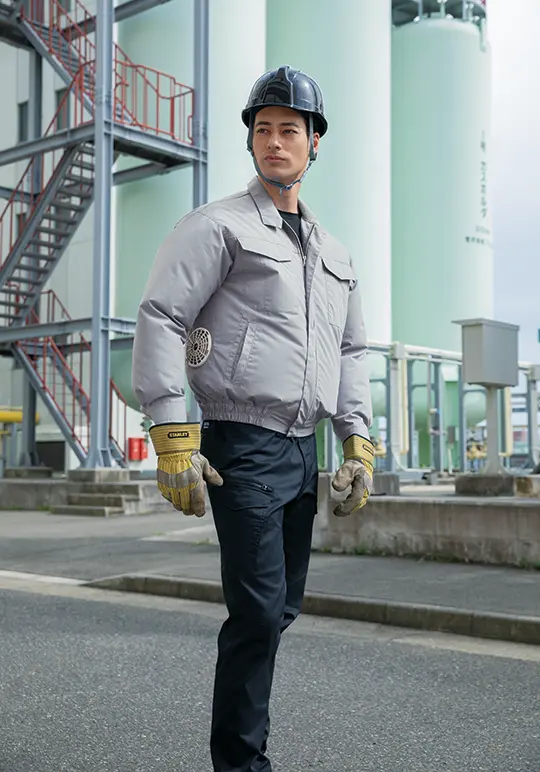
Two decades after launch, the domestic market for fan-equipped garments has grown substantially—now shipping in the millions of units and approaching the equivalent of tens of billions of yen in value. The earliest adopters were workers in high-heat environments—construction, logistics, and factories—where the garments helped prevent heat-related illness and sustain performance. But the value proposition is broader. As society seeks low-energy, human-centered cooling, demand is rising in sports, outdoor recreation, and fashion. The same principles—light power draw, mobility, and comfort—translate naturally into such consumer contexts.
In this next phase, the advantage of “KUCHOFUKU” will come from ‘platform-thinking’: pairing core IP and know-how with modular form factors, materials innovation, energy-efficient power systems, and adaptable designs that serve both professional and lifestyle markets. Partnerships with apparel brands, equipment manufacturers, and sports organizations can unlock new categories while reinforcing the company’s role as the pioneer of wearable cooling.
Lessons for Innovators: Building from the Trunk, Not the Twigs
Asked what guidance he would offer to emerging inventors, Hiroshi Ichigaya resists prescriptive advice. Instead, he offers a way of seeing:
“If there were a tree of knowledge, think about how to grow branches from the trunk, not from the twigs. Hold a vision. Strive to understand many things—using power of imagination—and from there, create.”
The “KUCHOFUKU” story embodies that philosophy. It started with a fundamental question—how to cool people without accelerating climate harm—and led to a reframing that seems obvious only in hindsight: cool the person. The technical execution required patience, iteration, and courage to introduce a completely unprecedented product to the world. The business required trust, earned through humility and responsiveness. And the IP strategy ensured that the company’s distinct solution would remain viable as the market grew. The PCT pathway provided what every emerging innovation needs: time to prove the concept domestically while preserving the option to protect it globally.
For innovators everywhere, the message is as practical as it is inspiring: choose problems that matter. Look for leverage in first principles. Protect what’s unique. And build with the humility to learn from your users—especially when they are counting on you in the heat.