On the sidelines of the regional conference on Alternative Dispute Resolution (ADR), the World Intellectual Property Organization (WIPO) through its IP for Business Division (IPBD), organized the first IP Management Clinic (IPMC) in Qatar, in cooperation with the Ministry of Commerce and Industry (MOCI), the Qatar Research, Development and Innovation Council (QRDI) and the Qatar Science & Technology Park (QSTP).
The day opened with remarks from Mr. Abdulbasit Al Ajji, Director of Intellectual Property Rights Protection Dept, Ministry of Commerce and Industry (MOCI), Dr. Mohammed Al-Housani, Director of Research and Advocacy, Qatar Research, Development, and Innovation Council (QRDI) and Sarah Nassar (WIPO IPBD). The speakers underscored the importance of IP as a key business enabler, welcoming the IP Management Clinic as a practical program to bring IP from policy to practice for Qatari SMEs and startups. They highlighted the value of the MOCI-QRDI-WIPO partnership and set the tone for a hands-on program linking awareness, capacity building, and one-to-one mentoring. The event featured insightful presentations on key trends shaping the IP and innovation ecosystem — including the rise of the intangible economy, the convergence of IP rights, and the role of IP as both a driver of growth and a tool for risk management.
A dedicated session on Strategic Integration of IP, led by Mr. Raghid Shreih (HBKU), explored practical approaches to risk assessment and contract management, strengthening brand value through trademarks, and unlocking monetization opportunities via licensing, franchising, and strategic partnerships.

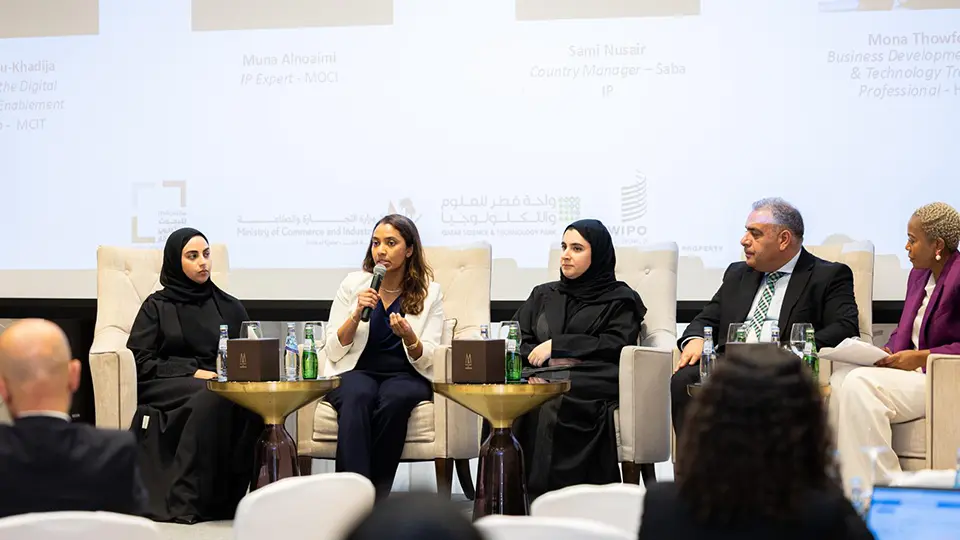
A panel discussion on “Navigating IP for Qatari SMEs: challenges, best practices and digital opportunities” brought together stakeholders from the Ministry of Commerce and Industry (MOCI), the Ministry of Communications and Information Technology (MCIT), and Saba IP and the Qatar Environment & Energy Research Institute (QEERI), who shared practical guidance on avoiding ownership and confidentiality pitfalls, sequencing domestic and international protection to match market entry, and using agreements and data governance to support digital business models.
A second panel brought the business perspective with Snoonu and ClearExhaust LLC. Snoonu highlighted that code, data and brand management, supported by trademarks and careful data governance, are central to scaling its platform. ClearExhaust explained that patenting and supplier agreements help move innovations from development to large scale applications. Both companies emphasized that disciplined IP practices accelerate partner negotiations, support fundraising and strengthen competitiveness.

“For a platform like Snoonu, IP is the code, the brand, the data and the partnerships. Getting that mix right is how you scale with confidence,” said Humza Khan, Chief Business & Strategy Officer, Snoonu.
The IP Strategy Game
Participants concluded the day with guided roundtable exercises built around a fictional US$10,000 budget. Working in small groups, they mapped the IP-relevant intangible assets on the Business Model Canvas, then selected and justified an appropriate mix of IP rights for their assigned case studies.
The exercise was first applied to real-world Qatari case studies featuring Snoonu and Mowasalat (Karwa), before being extended to each participant’s own business. This hands-on approach resulted in clear, actionable IP roadmaps tailored to each company’s unique context.

“The game distilled our choices into a clear sequence; confidentiality and brand first, with patents when timing and invention justify it,” said M.A. Sayeed, CTO, PearlQ Software and Network Solutions.
Deep dive consultations for SMEs
The second day focused on intensive one-on-one mentoring, featuring deep-dive diagnostic and strategy sessions held across multiple rooms. Twenty-four companies met with mentors for 75-minute sessions each. Discussions centered on mapping core intangible assets, clarifying ownership and confidentiality, and building a balanced portfolio across trade secrets, contractual measures, trademarks, industrial designs, and targeted patents. These portfolio decisions were then linked to commercialization pathways and international growth plans.
The mentoring team included WIPO representatives, along with local experts:
- Mr. Raghid Shreih, Commercialization Manager, Office of Innovation and Industrial Relations (OIIR), Hamad Bin Khalifa University (HBKU)
- Mr. Sami Nusair, Country Manager, Saba IP
- Ms. Mona Thowfeek, Senior IP and Business Development Specialist, Qatar Environment & Energy Research Institute (QEERI)
- Ms. Rosena Nhlabatsi, Senior IP Expert, Qatar Research, Development and Innovation Council (QRDI)
- Ms. Aisulu Anarbekova, IP and License Expert, (HBKU)
Experts also addressed the implications of IP decisions for partners and investors, explored entry strategies for priority markets, and clarified the evidence needed for the next review stage. These sessions will directly inform each company’s Final IP Strategy Roadmap and guide the upcoming online follow-up engagements.
“The individualized session made us step back and see IP as central to our business, not just paperwork. We left with clear priorities on what to protect and when, so our growth and partnerships are better supported.” Dr. Sarah Namany, QKONS Solutions

“The one-on-one mentoring clarified why IP matters for our products and brand. We now have practical next steps and the confidence to integrate IP decisions into our rollout.” Intiqab Rawoof, CEO, Premier Fintech.